CANADA HISTORY


The Vikings, often remembered as the fearsome raiders of Northwestern Europe, were also among the most accomplished seafarers in history. Their voyages across the Atlantic, particularly to North America, mark a fascinating chapter in early exploration, predating Christopher Columbus by nearly 500 years. Sailing in their iconic longboats, which were designed to withstand both the open seas and shallow rivers, the Vikings ventured into some of the most dangerous and inhospitable waters of the North Atlantic. The question of how far they explored, how many settlements they established, and how long they remained in North America remains a subject of intrigue and debate. Their presence, however brief, at places like L’Anse aux Meadows in Newfoundland holds significant importance to Canadian history and our understanding of early European interactions with Indigenous peoples on the continent.
The key to understanding Viking exploration in North America lies in the Icelandic sagas, a series of oral stories passed down through generations and later written down. These sagas tell the tale of Viking voyages, including those of Leif Erikson, who is believed to have landed in North America around the year 1000 AD. According to the sagas, the Vikings referred to this newly discovered land as Vinland, a place described as rich in resources, particularly timber and grapes. However, the exact location of Vinland has long been debated by historians and archaeologists, with many placing it somewhere along the coast of Newfoundland or perhaps further south.
Before their voyages to North America, the Vikings had already proven themselves as master navigators and explorers. Originating from Scandinavia—Norway, Sweden, and Denmark—the Vikings expanded their settlements across the northern reaches of Europe and beyond. By the late 8th century, the lack of arable land in Scandinavia, coupled with a growing population, drove many Vikings to seek new lands. This expansion began with terrifying raids on the British Isles, France, and Ireland in the late 790s AD, but soon turned into a broader exploration of the North Atlantic. They established settlements in the Orkney Islands, the Faroe Islands, Iceland, and Greenland, which served as stepping stones for their eventual journey to North America.
The Vikings' longboats were critical to their success as explorers. These ships were technological marvels for their time—lightweight, sturdy, and capable of being powered by either sail or oars. Their design allowed the Vikings to navigate the open ocean, as well as shallow rivers, enabling them to strike quickly and travel great distances. The ability to traverse the often stormy and treacherous North Atlantic in these vessels is a testament to Viking ingenuity and courage.
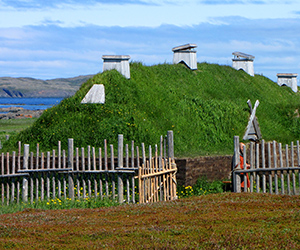
Around 1000 AD, Leif Erikson, the son of the famous explorer Erik the Red, set sail from Greenland and reached what is now believed to be the northern coast of Newfoundland. This site, known today as L’Anse aux Meadows, represents the first known European settlement in North America. Discovered in the early 1960s by Norwegian archaeologists Helge and Anne Stine Ingstad, L’Anse aux Meadows provided definitive archaeological evidence of Viking presence in the New World. The settlement has been partially excavated, and a reconstructed Viking village now stands on the site, offering visitors a glimpse into what life might have been like for these early explorers.
L’Anse aux Meadows is located on the northwest tip of Newfoundland, a region that remains cold and harsh for much of the year, with icebergs still drifting into nearby bays. Archaeological evidence suggests that the settlement was relatively small, likely housing no more than 100 Vikings at its peak. The site consisted of sod-covered wooden buildings, similar to those found in Greenland and Iceland, which were used as living quarters, workshops, and storage spaces. The remains of iron smelting furnaces and workshops indicate that the Vikings were not merely visitors but had established a functioning community, however short-lived it may have been.
The Indigenous peoples of Newfoundland, likely ancestors of the Beothuk, were already present in the area when the Vikings arrived. While initial interactions between the Vikings and the Indigenous peoples may have been peaceful, the sagas suggest that hostilities eventually broke out. The Saga of the Greenlanders and the Saga of Erik the Red both recount violent encounters between the Vikings and the Indigenous peoples they referred to as Skrælings. Although these sagas offer a valuable glimpse into Viking life and their ventures into North America, they are also full of embellishments and legend, making it difficult to separate fact from fiction. However, archaeological evidence from L’Anse aux Meadows suggests that the relationship between the Vikings and the Indigenous peoples was fraught with tension, contributing to the Vikings’ eventual departure from the region.
The departure of the Vikings from L’Anse aux Meadows remains one of the great mysteries of their exploration of North America. Despite their advanced navigation skills and the evidence that the area held valuable resources such as timber and fish, the Vikings abandoned their settlement after only a few years. The harsh climate, conflict with Indigenous peoples, and the difficulty of maintaining supply lines from Greenland may have all contributed to the decision to leave Vinland behind. The Viking settlement in North America was short-lived, and by the early 11th century, the Vikings had retreated from the continent entirely.
The discovery of L’Anse aux Meadows was a groundbreaking moment in Canadian history, as it provided the first concrete evidence that Europeans had reached North America long before Columbus. For centuries, the sagas were dismissed as little more than myth, but the archaeological findings in Newfoundland confirmed that the Vikings had indeed made their way to the shores of North America. This discovery rewrote the history of exploration in the Americas and solidified the Vikings’ place as some of the earliest European visitors to the continent.
The Viking presence in Newfoundland, though brief, holds significant relevance for Canadian history. It highlights the early connections between Europe and North America and underscores the vastness and complexity of pre-Columbian exploration. The settlement at L’Anse aux Meadows also reflects the rich history of Indigenous peoples in the region, who had established thriving communities long before the arrival of the Vikings. The interaction between these two cultures, though limited, marked the first known encounter between Indigenous North Americans and Europeans, setting the stage for centuries of exploration, trade, and conflict that would follow.
Furthermore, the Viking exploration of North America serves as a reminder of the importance of maritime exploration in shaping the history of Canada. The harsh conditions of the North Atlantic, which the Vikings bravely navigated, continue to be a defining feature of Canada’s coastal regions. The site at L’Anse aux Meadows has become an iconic symbol of early exploration and is now a UNESCO World Heritage Site, drawing visitors from around the world to learn about the Viking voyages and their place in Canadian history.
In conclusion, the Viking exploration of North America, particularly their settlement at L’Anse aux Meadows, is a crucial chapter in the history of Canadian exploration. It challenges the traditional narrative of European discovery in the New World, predating the voyages of Columbus by nearly 500 years. While the Viking presence in Newfoundland was short-lived, their voyages across the North Atlantic demonstrated remarkable seafaring skill and courage. The archaeological evidence at L’Anse aux Meadows confirms the historical accuracy of the sagas and provides a tangible connection to this early period of European exploration. The Vikings’ journey to North America marks the beginning of a long and complex history of European-Indigenous interactions in Canada, one that would continue to shape the nation’s development for centuries to come.
Cite Article : www.canadahistory.com/sections/documents