CANADA HISTORY

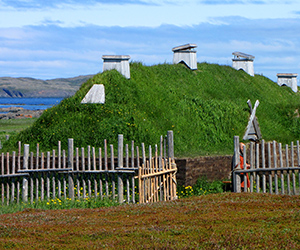
There were great discussions at Brattahlid that winter about going in search of Vinland 1 where, it was said, there was excellent land to be had. The outcome was that Karlsefni and Snorri Thorbrandsson prepared their ship and made ready to search for Vinland that summer. Bjarni Grimolfsson and Thorhall Gamlason decided to join the expedition with their own ship and the crew they had brought from Iceland.There was a man named Thorvard, who was Eirik the Red's son-in-Iaw . There was another man named Thorhall, who was known as Thorhall the Hunter; he had been in Eirik's service for a long time, acting as his huntsman in summer, and had many responsibilities. He was a huge man, swarthy and uncouth; he was getting old now, bad-tempered and cunning, taciturn as a rule but abusive when he spoke, and always a trouble-maker. He had not had much to do with Christianity since it had come to Greenland. He was not particularly popular, but Eirik and he had always been close friends. He went with Thorvald and the others because he had considerable experience of wild regions! They had the ship that Thorbjorn Vifilsson had brought from Iceland, and when they joined Karlsefni there were mostly Greenlanders on board. Altogether there were 160 people taking part in this expedition. They sailed first up to the Western Settlement, and then to the Bjarn Isles? From there they sailed before a northerly wind and after two days at sea they sighted land and rowed ashore in boats to explore it. They found there many slabs of stone so huge that two men could stretch out on them sole to sole. There were numerous foxes there. They gave this country a name and called it Helluland. From there they sailed for two days before a northerly wind and sighted land ahead; this was a heavily-wooded country abounding with animals. There was an island to the south-east, where they found bears, and so they named it Bjarn Isle; they named the wooded mainland itself Markland. After two days they sighted land again and held in towards it; it was a promontory they were approaching. They tacked along the coast, with the land to starboard. It was open and harbourless, with long beaches and extensive sands. They went ashore in boats and found a ship's keel on the headland, and so they called the place Kjalarness. They called this stretch of coast Furdustrands6 because it took so long to sail past it. Then the coastline became indented with bays and they steered into one of them. When Leif Eirikson had been with King Qlaf Tryggvason and had been asked to preach Christianity in Greenland, the king had given him a Scottish couple, a man called Haki and a woman called Hekja. The king told Leif to use them if he ever needed speed, for they could run faster than deer. Leif and Eirik had turned them over to Karlsefni for this expedition. When the ships had passed Furdustrands the two Scots were put ashore and told to run southwards to explore the country's resources, and to return within three days. They each wore a garment called a bjafal,l which had a hood at the top and was open at the sides; it had no sleeves and was fastened between the legs with a loop and button. That was all they wore.The ships cast anchor there and waited, and after three days the Scots came running down to the shore; one of them was carrying some grapes, and the other some wild wheat. They told Karlsefni that they thought they had found good land. They were taken on board, and the expedition sailed on until they reached a fjord. They steered their ships into it. At its mouth lay an island around which there flowed very strong currents, and so they named ii Straum Island. There were so many birds 2 on it that one could scarcely set foot between their eggs. They steered into the fjord, which they named Straumfjord; here they unloaded their ships and settled down. They had brought with them livestock of all kinds and they looked around for natural produce. There were mountains there and the country was beautiful to look at, and they paid no attention to anything except exploring it. There was tall grass everywhere. They stayed there that winter, which turned out to be a very severe one; they had made no provision for it during the summer, and now they ran short of food and the hunting failed. They moved out to the island in the hope of finding game, or stranded whales, but there was little food to be found there, although their livestock throve. Then they prayed to God to send them something to eat, but the response was not as prompt as they would have liked. Meanwhile Thorhall the Hunter disappeared and they went out to search for him. They searched for three days; and on the fourth day Karlsefni and Bjarni found him on top of a cliff. He was staring up at the sky with eyes and mouth and nostrils agape, scratching himself and pinching himself and mumbling. They asked him what he was doing there; he replied that it was no concern of theirs, and told them not to be surprised and that he was old enough not to need them to look after him. They urged him to come back home with them, and he did. A little later a whale was washed up and they rushed to cut it up. No one recognized what kind of a whale it was, not even Karlsefni, who was an expert on whales. The cooks boiled the meat, but when it was eaten it made them all ill. Then Thorhall the Hunter walked over and said, 'Has not Redbeard 1 turned out to be more successful than your Christ ? This was my reward for the poem I composed in honour of my patron, Thor; he has seldom failed me.' When the others realized this they refused to use the whale. meat and threw it over a cliff, and committed themselves to God's mercy. Then a break came in the weather to allow them to go out fishing, and after that there was no scarcity of provisions. In the spring they went back to Straumfjord and gathered supplies, game on the mainland, eggs on the island, and fish from the sea.
Cite Article : www.canadahistory.com/sections/documents