CANADA HISTORY
Sir Humphrey Gilbert was a pivotal figure in the early exploration and colonization efforts of the British Empire in North America, laying the groundwork for what would eventually become a cornerstone of British imperial expansion. Educated at Oxford and a member of Queen Elizabeth’s household before she ascended the throne, Gilbert was not only a man of action but also a visionary intellectual. His ambition and ideas contributed significantly to the early exploration of North America and the concept of colonization, despite the ultimate failure of his own settlement efforts. His story remains crucial to understanding the roots of British North American expansion and its long-term impact on Canadian history.
Gilbert’s intellectual contributions to the exploration of the New World are often overshadowed by his later expeditions, but his early work was groundbreaking. In 1576, he published A Discourse of a Discoveries for a Passage to Cataia, a treatise advocating for the search for a Northwest Passage, a route to the rich markets of Asia that would bypass the perilous routes controlled by Spain and Portugal. Gilbert’s argument was simple yet profound: the future prosperity and global power of England depended on finding this elusive passage. His book became an influential text in its time, inspiring figures such as Martin Frobisher and John Davis to mount their own expeditions in search of the Northwest Passage. These explorers followed Gilbert’s vision and attempted to chart a path through the icy waters of the Arctic, further embedding the idea of northern exploration in England’s imperial ambitions.
While the Northwest Passage remained elusive for centuries, Gilbert’s contribution to its pursuit cannot be understated. His ideas were also important in shaping the ambitions of Queen Elizabeth I, who supported Frobisher’s second voyage in 1577. Gilbert’s half-brother, Sir Walter Raleigh, would later play a similarly influential role in early English colonial efforts, notably at Roanoke Island, but it was Gilbert who first paved the way for England’s claims in the New World.
Gilbert’s own colonial ambitions took shape with his campaign to establish English settlements in North America. In 1578, he successfully secured Letters of Patent from Queen Elizabeth, granting him the authority to plant an English colony in the New World. This royal endorsement was a major milestone, giving Gilbert the legal and political backing to begin his venture. His goal was to establish a permanent English presence in North America, securing England’s claim to lands that had previously been explored by other European powers, particularly Spain and Portugal. The significance of this moment in history cannot be overstated, as it marked one of the earliest English efforts to lay a permanent claim to the New World, a claim that would eventually evolve into British North America.
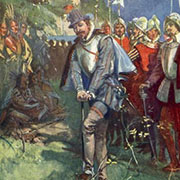
On June 11, 1583, Gilbert set sail from Plymouth with a small fleet of five ships, embarking on what he hoped would be a monumental voyage. After several challenges and setbacks, including the loss of two ships, Gilbert and his remaining vessels arrived at the harbor of St. John’s, Newfoundland, on August 5, 1583. This was a defining moment in the history of British exploration, as it marked the first time that an Englishman officially claimed land in North America for England. During a formal ceremony, Gilbert turned the sod, symbolizing the establishment of an English colony in Newfoundland, and laid England’s claim to the land under Queen Elizabeth’s rule.
This act of claiming Newfoundland was a significant precursor to future British territorial claims in the New World. Newfoundland, with its rich fishing waters, had already attracted European interest, and Gilbert’s landing was England’s first official step toward asserting control over the territory. Though the colonization of Newfoundland did not immediately succeed, the precedent set by Gilbert's claim would later become the basis for further English settlements in what is now Canada and beyond. The long-term impact of this claim can be seen in the eventual establishment of Newfoundland as Britain’s first overseas colony and its role in shaping Canada’s colonial history.
Despite his historic claim, the settlement of St. John’s quickly encountered difficulties. The colonists, who had initially been attracted by the promise of riches, were more interested in searching for gold than in building a sustainable colony. This focus on wealth rather than infrastructure doomed the settlement to failure, as the lack of proper planning, resources, and leadership led to its abandonment. Gilbert’s dream of creating a thriving English colony in Newfoundland collapsed before it could take root, and the settlers left behind little more than a fleeting presence.
Gilbert himself would not live to see the outcome of his colonization efforts. As summer turned to fall, he decided to sail back to England, leaving Newfoundland behind. His return voyage proved disastrous. On September 9, 1583, while sailing aboard the Squirrel, a small ship that was part of his fleet, Gilbert was urged by the crew of the Golden Hind to transfer to their larger vessel for safety. Refusing, he famously remarked, “We are as near to heaven by sea as by land.” That night, the Squirrel was engulfed by the sea, and Gilbert perished, along with his remaining crew.
Gilbert’s tragic death at sea marked the end of his personal efforts to establish a colony in North America, but his legacy lived on. The failure of the St. John’s settlement did not deter future English colonization efforts, and it is important to recognize Gilbert’s role in setting the stage for later ventures. His claim to Newfoundland was the beginning of England’s long-standing involvement in the Atlantic fisheries, a critical industry that would sustain European interest in the region for centuries to come. Furthermore, his expedition laid the groundwork for subsequent colonial endeavors, including those of his half-brother, Sir Walter Raleigh, and other English explorers who continued to seek a foothold in North America.
In Canadian history, Sir Humphrey Gilbert’s 1583 claim to Newfoundland holds special importance. While the settlement he attempted to establish was short-lived, his actions marked the first step in what would eventually become the British colonization of Canada. Newfoundland remained a key British outpost, particularly in the fishing trade, and later served as a base for further exploration and settlement along the Atlantic coast. Gilbert’s exploration and claim were critical in establishing the British presence in the region, a presence that would evolve into a full-fledged colonial enterprise with profound implications for the development of Canada as a nation.
In conclusion, Sir Humphrey Gilbert’s life and expeditions were significant not only for their immediate impacts but for their lasting influence on the history of British exploration and colonization. His intellectual contributions to the search for the Northwest Passage inspired future expeditions, and his 1583 claim to Newfoundland laid the foundation for Britain’s territorial ambitions in the New World. Although his colony at St. John’s failed, Gilbert’s actions established a British presence in North America that would persist and grow over the following centuries, helping to shape the early colonial history of what would eventually become Canada. His legacy, both in the realm of exploration and in the broader context of British imperial expansion, remains a cornerstone in the story of Canada’s origins.
Cite Article : www.canadahistory.com/sections/documents