CANADA HISTORY
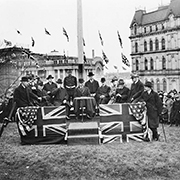
The 1917 conscription crisis and the election that followed were defining moments in Canadian history, shaping the nation's political landscape and creating a long-lasting rift between English and French Canada. At the heart of this division was the question of conscription, or mandatory military service, which pitted patriotic duty and loyalty to the British Empire against the cultural and political autonomy of French Canadians, many of whom felt little connection to Britain’s imperial interests. The events that unfolded during this period left an indelible mark on Canada’s political history, influencing relations between French and English Canadians for generations and altering the trajectory of political parties.
The Road to Conscription: A Divided Nation
When World War I broke out in 1914, Canada, as part of the British Empire, was automatically drawn into the conflict. At the outset, recruitment for the Canadian Expeditionary Force (CEF) was voluntary, and thousands of men enlisted to fight overseas. By the end of 1914, more than 59,000 Canadians had joined the military. However, as the war dragged on and Canadian casualties mounted, it became increasingly difficult to maintain the number of soldiers needed to sustain the war effort. By 1917, the number of new volunteers was insufficient to replace those who had been killed or injured on the front lines. Prime Minister Robert Borden, returning from the Imperial War Conference in London in 1917, was convinced that conscription was the only solution to meet Canada's military commitments.
The decision to introduce conscription was not made lightly. Borden understood that it would provoke strong opposition, particularly in Quebec, where French Canadians had little enthusiasm for fighting in a war they viewed as a British conflict. Wilfrid Laurier, leader of the Liberal Party and former Prime Minister, was keenly aware of this sentiment. Although Laurier understood the rationale behind conscription, he knew he could not support it without alienating his political base in Quebec. Borden, recognizing the gravity of the situation, invited Laurier to join a Union Government, a coalition of political parties united for the purpose of prosecuting the war. Laurier declined, setting the stage for a divisive national election that would be fought almost entirely on the issue of conscription.
Political Maneuvering and the Birth of the Union Government
Facing the growing divide, Borden extended the life of Parliament by one year, with the agreement of both the Liberals and Conservatives, to carry out the nation’s war plans. However, upon his return from London in 1917, Borden realized that an election was inevitable. He knew that conscription would be the central issue, and he needed a broad base of support to implement it. As more and more Liberal MPs began to break ranks and join Borden’s cause, the idea of a Union Government gained traction.
Borden’s strategy to secure support for conscription was politically savvy. He passed legislation such as the Military Voters Act, which extended the right to vote to soldiers, and the Wartime Elections Act, which enfranchised women who had close male relatives serving in the military, such as mothers, wives, and sisters. These measures were designed to bolster support for the pro-conscription Union Government, particularly among English Canadians. At the same time, Borden’s government disenfranchised recent immigrants from Germany and Austria, who were considered “enemy aliens.” These immigrants had been in Canada for fewer than 15 years and were believed to harbor sympathies for their countries of origin. These electoral changes dramatically altered the voting landscape, particularly in favor of Borden’s Union Government.
The Election of 1917: A Nation Divided
The December 1917 election was one of the most contentious in Canadian history, marked by a deep divide between English and French Canadians. The Union Government, led by Borden, campaigned on a platform of conscription and patriotic duty to support the British Empire. In contrast, Laurier and the Liberal Party ran a campaign opposing conscription, advocating for voluntary enlistment and emphasizing the need to respect Quebec’s unique cultural identity.
The election results reflected the deep regional and linguistic divisions within the country. Borden’s Union Government secured a decisive victory, winning 74 of Ontario’s 82 seats, 55 of the West’s 57 seats, and a majority of seats in the Maritimes. The Union Government’s platform resonated strongly with English Canada, where support for the war and conscription was high. However, in Quebec, Borden’s government was almost entirely shut out. Laurier’s opposition to conscription helped him win 62 of Quebec’s 65 seats, demonstrating the depth of anti-conscription sentiment in the province.
The election laid bare the fractured nature of Canadian unity. While the Union Government won a strong mandate in most of the country, it was virtually absent in Quebec. The conscription crisis had effectively split the country along linguistic lines, with English Canadians rallying behind Borden and French Canadians supporting Laurier’s opposition to forced military service.
Conscription’s Aftermath and Political Consequences
Although Borden’s Union Government won the 1917 election and successfully implemented conscription through the Military Service Act, the conscription crisis left a deep scar on Canadian politics. The introduction of conscription did little to significantly increase the number of soldiers fighting overseas. By the time the war ended in November 1918, the number of conscripts who actually saw combat was limited, and the system was plagued by inefficiency and public unrest.
The conscription crisis also had a lasting impact on the political landscape of Canada. The Conservative Party, which had been the dominant political force in the country for much of its early history, became deeply unpopular in Quebec due to its role in enforcing conscription. The divide between Quebec and the rest of Canada, which had been exposed during the crisis, would linger for decades and resurface again during World War II when the issue of conscription reemerged. The Conservative Party would struggle to regain significant political support in Quebec for much of the 20th century, with only occasional periods of reconciliation, such as during the Mulroney era in the 1980s.
The Union Government, while successful in governing for the remainder of the war, dissolved after Borden’s retirement in 1920. Without Borden’s leadership, many of the Liberal members who had joined the Union Government returned to the Liberal Party, while others formed new political movements, such as the Progressive Party, which would become a significant force in the post-war era.
For Wilfrid Laurier, the 1917 election marked the final chapter of his long political career. Although he lost the election, Laurier remained a towering figure in Canadian politics, and his decision to oppose conscription endeared him to French Canadians, ensuring his legacy as a defender of their rights and identity.
Long-Term Impact on Canadian Identity
The conscription crisis of 1917 was a pivotal moment in the development of Canadian identity. It exposed the deep linguistic, cultural, and political divisions within the country, particularly between English and French Canadians. While English Canada largely viewed the war as a noble effort to defend the British Empire and democracy, French Canada saw it as a distant and irrelevant conflict. These differing perspectives were exacerbated by the introduction of conscription, which French Canadians viewed as an imposition of British imperialism.
The crisis also forced Canada to confront the limits of its unity as a nation. The conflict between Borden and Laurier, and between the Union Government and Quebec, demonstrated that the country was not yet a fully cohesive entity. The tension between Quebec’s desire for cultural and political autonomy and the rest of Canada’s loyalty to the British Empire would continue to shape Canadian politics throughout the 20th century.
At the same time, the conscription crisis helped to lay the groundwork for Canada’s eventual independence from Britain. While Canada remained part of the British Empire during World War I, the conflict and the conscription debate highlighted the country’s growing sense of national identity and the need for greater autonomy in making decisions about its own affairs. This process would continue in the years after the war, culminating in the passage of the Statute of Westminster in 1931, which gave Canada control over its own foreign policy.
A Legacy of Division and Unity
The conscription crisis of 1917 was one of the most divisive events in Canadian history. It fractured the country along linguistic and cultural lines, creating a deep divide between English and French Canadians that would take decades to heal. The Union Government led by Robert Borden managed to win the war, but the political and social costs were significant. The Conservative Party's decline in Quebec and the enduring tensions between the two solitudes of Canada were direct consequences of this period.
However, the crisis also played a role in shaping Canada’s national identity. The war effort, combined with the intense political debates surrounding conscription, helped to solidify Canada’s position as a distinct entity within the British Empire and laid the groundwork for greater independence. The legacy of the conscription crisis continues to influence Canadian politics and society, serving as a reminder of both the challenges and strengths of a diverse, bilingual, and multicultural nation.
Cite Article : www.canadahistory.com/sections/documents