CANADA HISTORY
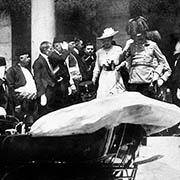
The assassination of Archduke Franz Ferdinand in Sarajevo on June 28, 1914, by Gavrilo Princip, a member of the Serbian nationalist group The Black Hand, was the spark that ignited a global conflict that would devastate much of Europe and change the course of history. The assassination was not just a tragedy for Austria-Hungary, but an event that triggered a series of diplomatic crises and military actions, leading to the First World War, or the Great War, as it came to be known. What followed was a war that would redraw the map of Europe, disintegrate empires, shift the balance of global power, and result in the deaths of millions, including many thousands of Canadians.
When Austria-Hungary issued an ultimatum to Serbia on July 23, 1914, the world watched nervously. The ultimatum was designed in such a way that Serbia could not accept it without severe humiliation, essentially forcing a confrontation. Russia, seeing itself as the protector of Slavic nations and determined to prevent Austro-Hungarian dominance in the Balkans, pledged to support Serbia. This set off a chain reaction of military mobilizations. Germany, allied with Austria-Hungary, saw this as an opportunity to strike decisively against Russia and France before Russia's military could fully modernize. Germany’s Schlieffen Plan, a military strategy designed to avoid a prolonged two-front war, required a quick victory over France before turning east to confront Russia.
By July 28, Austria-Hungary declared war on Serbia. The dominoes fell rapidly: Russia mobilized on July 31, Germany declared war on Russia on August 1, and war on France on August 3. When Germany invaded neutral Belgium on August 4, violating the Treaty of London of 1839 that guaranteed Belgian neutrality, it forced Britain to declare war on Germany the same day. As part of the British Empire, Canada was now at war as well.
Canada Enters the War
Canada’s involvement in the First World War was automatic, as foreign policy decisions were still under the control of Britain in 1914. However, the Canadian government and much of the public embraced the war with enthusiasm. Prime Minister Robert Borden quickly committed 25,000 Canadian soldiers to support Britain, although this number would grow dramatically over the next four years. By the end of the war, 620,000 Canadians had served in the military, including many volunteers eager to support Britain and the Allied cause.
Canada’s early response was enthusiastic, driven by a combination of patriotism, loyalty to the British Empire, and a sense of adventure. For many, the war was seen as an opportunity to prove Canada’s worth on the global stage and to help Britain, the "mother country." Thousands of Canadians from all walks of life enlisted, including many recent British immigrants who still felt strong ties to their homeland. Canada’s contributions to the war effort, however, went far beyond sending troops. The country also became a major supplier of food, munitions, and other war materials to Britain and the Allies, transforming its economy in the process.
The Schlieffen Plan and Trench Warfare
Germany’s Schlieffen Plan was based on a quick and decisive victory over France by bypassing its fortifications through neutral Belgium and Luxembourg. The plan, however, did not go as smoothly as the Germans hoped. Belgium put up unexpected resistance, and the arrival of the British Expeditionary Force (BEF) further delayed the German advance. The result was a stalemate on the Western Front, with both sides digging in for a war of attrition that would last for four years. The quick victory Germany had hoped for never materialized, and the war descended into the horrors of trench warfare.
The Western Front became a static line of trenches stretching from the North Sea to Switzerland, where millions of soldiers from both sides endured years of unimaginable hardship. Soldiers lived in muddy, rat-infested trenches, exposed to constant artillery bombardments, poison gas attacks, and the ever-present threat of death or injury. The war on the Western Front became a brutal contest of endurance, with battles like Verdun, the Somme, and Ypres claiming hundreds of thousands of lives, often for minimal territorial gain.
Canada, which had sent its soldiers to Europe with optimism and a sense of duty, was drawn into this carnage. The Canadian Expeditionary Force (CEF), formed in 1914, would distinguish itself in numerous battles, but the cost in lives would be staggering. It was in this horrific environment that Canadian soldiers would forge a new sense of national identity.
The Battle of Vimy Ridge and Canadian Nationalism
One of Canada’s most significant contributions to the war—and one that had a lasting impact on the country’s sense of identity—was the Battle of Vimy Ridge in April 1917. Vimy Ridge was a strategically important high ground in northern France that had been heavily fortified by the Germans. Previous attempts by the French and British to capture the ridge had failed with heavy casualties.
The Canadian Corps, under the command of General Julian Byng, was tasked with capturing the ridge. After extensive planning, training, and preparation, the Canadians launched their assault on April 9, 1917. The attack was a stunning success. The Canadians took the ridge in just a few days, achieving what other Allied forces had failed to do. The victory at Vimy Ridge was not only a significant military achievement, but it also became a symbol of Canadian nationalism. For the first time, all four Canadian divisions had fought together, and they had done so with great success.
Vimy Ridge became a defining moment in Canada’s history. It was seen as the moment when Canada "came of age" as a nation, proving itself on the world stage and earning the respect of its Allies. The victory at Vimy Ridge fostered a new sense of national pride and identity, helping to distinguish Canada from Britain and solidifying its reputation as a capable and independent force in international affairs.
The Conscription Crisis of 1917
While Canada’s military achievements abroad helped to foster a sense of national pride, the war also exposed deep divisions within Canadian society, particularly between English and French Canadians. These tensions came to a head in 1917, when Prime Minister Borden introduced conscription to address the declining number of volunteers for the war effort. By 1917, Canadian casualties were mounting, and the voluntary enlistment system was no longer sufficient to maintain the necessary troop levels.
Borden introduced the Military Service Act, which made military service compulsory for men aged 20 to 45. While conscription was widely supported in English Canada, it was deeply unpopular in Quebec, where many French Canadians felt no loyalty to Britain or the British Empire. They saw the war as a European conflict that had little relevance to their lives. Wilfrid Laurier, the leader of the Liberal Party, opposed conscription, warning that it would divide the country.
The Conscription Crisis created a sharp divide between English and French Canadians and led to widespread protests in Quebec. In the 1917 federal election, Borden’s Unionist government, which was a coalition of Conservatives and pro-conscription Liberals, won a decisive victory, but Quebec overwhelmingly voted against the government. The issue of conscription left a lasting scar on Canadian politics and deepened the cultural and linguistic divisions that had existed since Confederation.
The Versailles Peace Conference and Canada’s Growing Autonomy
The end of the war in November 1918 marked the beginning of a new era for Canada, both internationally and domestically. Prime Minister Borden was determined that Canada’s immense contributions to the war effort should be recognized. He successfully insisted that Canada have its own seat at the Versailles Peace Conference in 1919, a significant step toward Canadian autonomy.
At Versailles, Canada signed the Treaty of Versailles independently of Britain, a symbolic gesture that underscored its growing independence. While Canada was still part of the British Empire, the war had demonstrated that it was no longer simply a colonial appendage. The signing of the treaty was a precursor to the Statute of Westminster in 1931, which granted Canada full control over its own foreign policy and marked its emergence as a fully sovereign nation.
Conclusion: A Nation Transformed
The First World War was a defining moment in Canadian history. The war not only tested Canada’s resolve but also reshaped its national identity. The experiences of Canadian soldiers on the battlefields of Europe, particularly at Vimy Ridge, fostered a sense of national pride and unity that transcended the country’s colonial origins. At the same time, the war exposed deep divisions within Canadian society, particularly over the issue of conscription, which would have lasting political and cultural consequences.
By the end of the war, Canada had emerged as a more autonomous and self-confident nation. Its contributions to the war effort had earned it a place on the world stage, and its participation in the Versailles Peace Conference signaled the beginning of its transition to full sovereignty. The war had forged Canada’s national identity in the fires of battle, but it had also left behind a divided and, in many ways, changed country. The Great War not only altered the geopolitical landscape of Europe but also fundamentally transformed Canada’s place in the world and its sense of itself.
Cite Article : www.canadahistory.com/sections/documents