CANADA HISTORY
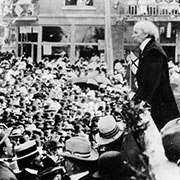
Wilfrid Laurier’s declaration that the twentieth century would belong to Canada remains one of the most memorable and hopeful visions ever articulated by a Canadian Prime Minister. Laurier’s confidence in Canada’s potential as a thriving, modern, and united country, rich in resources and diverse in culture, was a hallmark of his political philosophy. A central aspect of Laurier’s approach to governance and nation-building was what he famously called "the sunny way"—a method of achieving political solutions through compromise, understanding, and conciliation, rather than through confrontation or coercion. One of the most prominent examples of Laurier’s "sunny way" was his handling of the Manitoba Schools Question, a divisive issue that tested his political acumen, his vision for Canada, and his leadership of the country.
Background of the Manitoba Schools Question
The Manitoba Schools Question was one of the most complex and volatile political issues of the late 19th century. It arose from the Manitoba Act of 1870, which had provided protections for the province's French-speaking Roman Catholic minority. These protections included the right to maintain separate schools for Roman Catholics, as well as the right to receive religious instruction in French.
However, by the 1890s, the demographic makeup of Manitoba had changed significantly, with an influx of English-speaking Protestant settlers who began to outnumber the province’s French Catholic population. Responding to this shift, Premier Thomas Greenway’s government passed the Public Schools Act of 1890, which effectively abolished funding for Catholic schools and mandated that all public schools in Manitoba be non-denominational. This legislation was seen as a direct assault on the rights of the French Catholic minority, sparking a fierce debate and creating political divisions between English Protestants and French Catholics not only in Manitoba but also across Quebec and English Canada.
The federal government, led by Conservative Prime Minister Sir John Thompson and later Sir Mackenzie Bowell, initially sought to impose a remedial bill that would force Manitoba to restore funding for Catholic schools. This approach was highly confrontational and exacerbated tensions between the provinces and the federal government. It also deepened the divide between Quebec’s French-speaking population, who saw the remedial bill as a necessary defense of minority rights, and English Canadians, many of whom supported Manitoba’s decision to secularize its public school system.
By the time Laurier came to lead the Liberal Party, the Manitoba Schools Question had become a defining issue in Canadian politics, threatening to tear apart the fragile unity of the country. Laurier, a devout Roman Catholic and the first French Canadian to lead a national political party, understood the delicate nature of the issue. He was determined to find a solution that would satisfy both French Catholics in Quebec and English Protestants in the rest of Canada. His genius lay in his ability to craft a solution through negotiation rather than compulsion, earning him widespread admiration and political success.
The "Sunny Way" Speech
In his now-famous speech in Morrisburg, Ontario on October 8, 1895, Laurier laid out his vision for resolving the Manitoba Schools Question. He criticized the heavy-handed approach of the Conservative government, which had sought to impose a federal solution on Manitoba by force. Laurier rejected the notion that such a divisive issue could be solved through compulsion, stating:
“If it were in my power, I would try the sunny way. I would approach this man Greenway with the sunny way of patriotism, asking him to be just and to be fair, asking him to be generous to the minority, in order that we may have peace among all creeds and races which it has pleased God to bring upon this corner of our common country. Do you not believe that there is more to be gained by appealing to the heart and soul of men rather than by trying to compel them to do a thing?”
Laurier’s reference to the "sunny way" emphasized his belief in appealing to people’s better nature, rather than relying on the coercive power of government. He argued that by negotiating in good faith and fostering mutual understanding, it was possible to find a peaceful, enduring solution that would respect the rights of all Canadians.
This approach reflected Laurier’s broader political philosophy, which sought to reconcile the competing interests of Canada’s diverse population. He understood that Canada, as a bilingual, bicultural nation, required leadership that could navigate the complexities of its cultural, linguistic, and religious divisions. Laurier’s speech in Morrisburg was a call for unity, tolerance, and compromise—values that he believed were essential for the country’s future success.
The Compromise Solution
Once elected as Prime Minister in 1896, Laurier immediately set to work on resolving the Manitoba Schools Question using the "sunny way." He opened negotiations with Premier Thomas Greenway and quickly realized that neither side could have everything they wanted. A compromise was necessary, and Laurier was uniquely positioned to broker it. His Catholic faith and fluency in French helped him gain the trust of Quebec’s bishops and political leaders, while his commitment to federalism and individual rights appealed to English-speaking Canadians.
The solution Laurier brokered was a compromise that reflected his pragmatic leadership. While the provincial government of Manitoba would no longer fund Catholic schools, certain concessions were made to protect the rights of Roman Catholics. Under the new agreement, Catholic students would be allowed to receive religious instruction in public schools for thirty minutes at the end of the school day. Additionally, in schools where numbers warranted it, French-language instruction would be provided, ensuring that the rights of French Catholics were respected without undermining the secular nature of the public school system.
Laurier’s solution managed to diffuse one of the most contentious issues in Canadian politics without deepening the cultural divide between French and English Canadians. The agreement struck a delicate balance, allowing Manitoba to maintain its secular public school system while still protecting the rights of religious minorities. The fact that the issue was resolved through negotiation and compromise rather than through federal intervention was a testament to Laurier’s political skill.
Quebec’s Reaction and Laurier’s Diplomatic Triumph
Laurier’s compromise did not sit well with everyone, particularly in Quebec, where the bishops of the Catholic Church had expected a more forceful defense of Catholic education. The bishops were initially outraged by Laurier’s willingness to concede ground on the issue, viewing it as a betrayal of the Catholic minority in Manitoba. The ultramontane faction of the church, which advocated for strong papal authority and close ties between the church and state, was particularly vocal in its criticism.
However, Laurier’s diplomatic finesse once again came to the fore. He took the unprecedented step of appealing directly to Pope Leo XIII, presenting his solution as a pragmatic compromise that would preserve the rights of Catholics in Manitoba while ensuring peace and stability in Canada. Laurier’s argument was compelling, and the Pope ultimately supported his position, instructing the Quebec bishops to accept the compromise for the good of the church and the country.
This diplomatic coup strengthened Laurier’s position both in Quebec and across Canada. By securing the support of the Pope, Laurier had effectively neutralized his critics within the church, while also reinforcing his reputation as a leader who could unite Canada’s disparate regions and communities.
The Long-Term Impact of the "Sunny Way"
The Manitoba Schools Question could have been a defining moment of division in Canadian history. However, Laurier’s "sunny way" approach turned it into a defining moment of conciliation and compromise. His ability to navigate the complexities of the issue without alienating either French or English Canada was crucial in maintaining the fragile unity of the country. It also demonstrated that political leadership in Canada required not only strength but also a deep commitment to finding peaceful solutions to divisive problems.
Laurier’s success in resolving the Manitoba Schools Question was emblematic of his broader vision for Canada. He believed that the 20th century would be Canada’s century—a time when the country’s unique combination of linguistic, cultural, and religious diversity would become its greatest strength. His leadership helped lay the foundation for a multicultural Canada, where differences were respected and unity was achieved through dialogue and compromise.
The "sunny way" became a guiding principle for Laurier’s time in office, and its legacy continues to shape Canadian politics today. His approach to the Manitoba Schools Question serves as a reminder of the importance of tolerance, patience, and understanding in a country as diverse as Canada. Laurier’s handling of the issue was not just a political triumph; it was a defining moment in the development of Canadian identity.
Cite Article : www.canadahistory.com/sections/documents