CANADA HISTORY
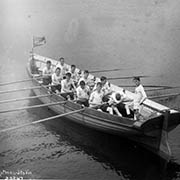
At the dawn of the 20th century, Canada faced a critical decision regarding its defense strategy, particularly its naval presence. Despite being a vast nation with extensive coastlines along the Atlantic and Pacific Oceans, Canada did not have its own navy and relied entirely on the Royal Navy for the protection of its waters, the enforcement of its territorial boundaries, and other specific missions. This reliance on the British Royal Navy was rooted in Canada's status as a Dominion within the British Empire, but by the turn of the century, the strategic realities of global power politics were forcing Canada to reassess its defense priorities. The creation of the Royal Canadian Navy (RCN) in 1910 under Prime Minister Wilfrid Laurier would be a watershed moment in Canadian history, symbolizing both the country's growing sense of sovereignty and the political challenges of balancing loyalty to Britain with the diverse interests within Canada.
The British Imperial Naval Strategy and the German Challenge
In the early 1900s, Britain's naval supremacy was being seriously challenged by a rising Germany. Under the leadership of Kaiser Wilhelm II, Germany embarked on a massive naval expansion, particularly the construction of a formidable fleet of battleships, including Dreadnoughts, that could rival the Royal Navy. The competition for control of the seas became known as the naval arms race, and it was a critical factor in the tense geopolitical climate of pre-World War I Europe. Britain's imperial strategy increasingly depended on the support of its Dominions, including Canada, to help maintain control over the world's oceans and protect the vast global trade routes that sustained the Empire.
To address this growing threat, Britain proposed that its Empire countries contribute to the strengthening of the Royal Navy by paying into a central fund that would be used to build more warships. This "imperial contribution" would help the Royal Navy retain its supremacy on the high seas against the expanding German High Seas Fleet. The underlying idea was that all parts of the Empire should participate in its defense, as they collectively benefited from the protection provided by the Royal Navy.
However, this proposal posed significant challenges for Canada. Although English Canadians generally supported greater involvement in the defense of the British Empire, French Canadians were deeply suspicious of any policies that tied Canada too closely to Britain's imperial military strategies. Memories of the Boer War, where Canadian troops had been sent to fight in South Africa for British interests, were still fresh, particularly among Quebec's population, which was already questioning the extent to which Canada should be involved in foreign wars. Laurier, himself a French Canadian, faced the difficult task of finding a compromise that would address these diverging views while maintaining Canada's relationship with Britain.
Wilfrid Laurier and the Naval Service Act
Wilfrid Laurier, who had served as Prime Minister of Canada since 1896, recognized the political complexities surrounding this issue. He understood that simply paying into the British naval program would be unpopular in Canada, especially in Quebec, where the idea of contributing Canadian funds to support British military ambitions was met with widespread opposition. At the same time, Laurier recognized the strategic importance of Canada having some form of naval capability to protect its own shores and contribute to the defense of the Empire in a way that would allow Canada to maintain a degree of autonomy.
In response, Laurier introduced the Naval Service Act on May 4, 1910, which created the Royal Canadian Navy (RCN). This was a compromise that Laurier believed would satisfy both the demands of the imperialists in English Canada and the concerns of nationalists in Quebec. The Naval Service Act provided for the establishment of a small, but distinctly Canadian, naval force that could assist Britain in times of emergency but would remain under Canadian control during peacetime. This force would be equipped with two aging warships purchased from Britain: the HMCS Niobe, stationed on the East Coast, and the HMCS Rainbow, stationed on the West Coast.
Laurier's plan was pragmatic in that it allowed Canada to participate in imperial defense without directly involving itself in Britain's arms race against Germany. The two ships were far from modern — in fact, they were nearly obsolete by the standards of the day — but they symbolized the beginning of Canada's ability to assert sovereignty over its own defense, while also offering a contribution to the defense of the Empire. In times of war, Laurier’s compromise allowed these ships to be deployed under the Royal Navy's command, fulfilling imperial obligations without full commitment to Britain's broader naval policy.
The Political Fallout: A Divided Nation
Despite Laurier’s best efforts, his compromise failed to win broad support and ultimately contributed to his downfall in the 1911 federal election. His policy managed to displease both sides of the political spectrum. English Canadians, particularly those with strong imperial loyalties, felt that Laurier had not gone far enough. They favored the idea of contributing funds directly to Britain's naval program to ensure that Canada was supporting the Empire's military dominance. They saw the small and under-equipped Canadian navy as inadequate in the face of the growing German threat. Many believed that Canada should have simply provided financial assistance to Britain for the construction of additional battleships that could serve in the North Sea against Germany.
Meanwhile, French Canadians, led by nationalist figures like Henri Bourassa, were vocally opposed to any involvement in Britain’s military affairs, whether through financial contributions or the creation of a Canadian navy. They feared that even a modest naval force could serve as a stepping stone to further entanglement in European conflicts. Bourassa argued that the Naval Service Act was just another way for Canada to be dragged into wars on Britain's behalf, much like the Boer War had done a decade earlier. He campaigned vigorously against Laurier, particularly in Quebec, framing the issue as one of Canadian independence versus imperial submission.
The result was that Laurier lost the election to Robert Borden and the Conservatives. Borden's party, while agreeing with the need for naval defense, campaigned on a platform that called for direct financial contributions to the Royal Navy rather than building a Canadian navy. This position resonated with many English Canadians who wanted Canada to contribute more directly to Britain's defense and also managed to break the Liberal stronghold in Quebec by playing into the fears of French Canadians that the new navy would ultimately serve British imperial interests.
The Early Years of the Royal Canadian Navy
Despite the political controversy, the Royal Canadian Navy was officially born with the passage of the Naval Service Act. The two ships, HMCS Rainbow and HMCS Niobe, were deployed to their respective coasts in 1910. HMCS Niobe arrived in Halifax, where it became the centerpiece of Canada's nascent Atlantic fleet, while HMCS Rainbow was stationed on the West Coast, operating out of the Esquimalt naval base near Victoria, British Columbia. Although both ships were considered outdated, they symbolized Canada's desire to take control of its own defense, particularly along its vulnerable coastlines.
In the Pacific, HMCS Rainbow conducted patrol duties, providing a measure of maritime security and maintaining a presence in Canadian waters. Meanwhile, on the East Coast, HMCS Niobe performed similar functions in the Atlantic, symbolizing Canada's growing naval capabilities. While these ships were far from the Dreadnoughts being built by Britain and Germany in their naval arms race, they marked the beginning of a distinctly Canadian approach to defense, separate from, but still linked to, Britain's naval power.
Relevance to Canadian History
The creation of the Royal Canadian Navy and the debates surrounding the Naval Service Act had lasting consequences for Canadian identity and its place within the British Empire. It marked an early effort by Canada to assert control over its own defense policy, which would be a recurring theme throughout the 20th century. This autonomy was further solidified during World War I, when Canadian forces operated under Canadian commanders, and during World War II, when the RCN played a crucial role in the Battle of the Atlantic.
Politically, the fallout from the Naval Service Act contributed to the collapse of Laurier's long tenure as Prime Minister and ushered in a new era of Conservative governance under Borden, who would lead Canada through the First World War. The controversy over the RCN also deepened the cultural and linguistic divisions within Canada, particularly between French and English Canadians, a division that would persist throughout much of the country's history.
Ultimately, the creation of the RCN was not just a response to British imperial strategy but also a significant step in Canada’s journey towards full sovereignty in military affairs. It laid the groundwork for the establishment of a modern Canadian Armed Forces and reflected the growing realization that Canada, while still part of the British Empire, needed to protect its own interests and contribute to the defense of its own shores. In this way, the Royal Canadian Navy was both a symbol of Canadian independence and a reminder of the country’s enduring ties to Britain.
Cite Article : www.canadahistory.com/sections/documents