CANADA HISTORY
In the early 1750s, a group of ambitious Virginia businessmen sought to capitalize on the fertile lands of the Ohio Valley by launching a commercial venture aimed at exploring and settling the region. This was a bold move, given that the French had already laid claim to vast swathes of territory in the Mississippi and Ohio River valleys. Between 1749 and 1754, French forces had actively established their presence in these areas, building forts and outposts to solidify their claims. In response to this French encroachment, the Virginia businessmen decided to take military action to assert British control over the contested territory. They raised a force of 300 men, led by a young, relatively inexperienced officer named George Washington.
In 1754, Washington embarked on an expedition into the Ohio Valley with the goal of challenging French dominance. His target was Fort Le Boeuf, a French post that served as a key stronghold in the region. However, Washington’s expedition met with disaster. The French forces, better prepared and entrenched, decisively defeated the Virginians, forcing Washington and his men to retreat back across the Appalachian Mountains. This early defeat was a significant setback for the British colonial effort to assert control over the Ohio Valley, but it marked only the beginning of a larger conflict that was brewing in the region.
Governor Robert Dinwiddie of Virginia, deeply concerned about French expansion into British-claimed territory, recognized the need for more substantial military support. He sent numerous urgent requests to the British government, imploring them to send reinforcements to defend the colony’s western frontier. His persistent lobbying eventually paid off, and in 1755, Britain responded by dispatching a military force under the command of General Edward Braddock. Braddock, a seasoned officer, was tasked with driving the French out of the Ohio Valley and securing British control. George Washington, who had gained valuable experience from his earlier campaign, joined Braddock's staff as an aide.
Braddock’s primary objective was to capture Fort Duquesne, a French stronghold located at the confluence of the Allegheny and Monongahela rivers, a strategic site that would later become Pittsburgh. His plan was to seize the fort and use it as a base from which to expel the French from the region. However, Braddock's campaign faced significant challenges. The French, anticipating British aggression, had reinforced their position in the Ohio Valley with 3,000 regular troops under the command of Baron Dieskau. Despite these formidable defenses, Braddock pressed forward with his mission.
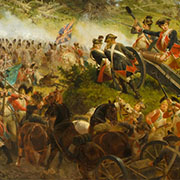
In July 1755, Braddock’s forces engaged the French and their Indigenous allies near Fort Duquesne in what would become a catastrophic defeat for the British. The French and their allies, familiar with the terrain and employing guerrilla tactics, ambushed Braddock’s column as it moved through dense wilderness. The British troops, trained for traditional European-style warfare, were ill-prepared for the hit-and-run tactics employed by their opponents. The result was a stunning and humiliating defeat for Braddock, who was mortally wounded in the battle. Washington, displaying remarkable courage under fire, helped lead the survivors back to safety, but the British had once again failed to secure the Ohio Valley.
These defeats in the Ohio Valley were not isolated incidents but rather the sparks that ignited a much larger global conflict. Although France and Britain were technically still at peace in Europe at the time, these skirmishes in the American frontier escalated tensions between the two powers. By 1756, the simmering hostilities in North America had spilled over into Europe, and the Seven Years’ War erupted in earnest. Often described as the first true world war, the Seven Years’ War saw fighting on multiple continents, including Europe, the Caribbean, India, and North America. The conflict would ultimately reshape the colonial map, with far-reaching consequences for both the British and French empires.
For Britain, the defeat in the Ohio Valley underscored the importance of securing its colonial interests in North America. The failure of Braddock’s campaign galvanized British leaders, including Prime Minister William Pitt, to redouble their efforts to defeat France in the New World. Pitt’s strategy, which involved using Britain’s superior naval power to cut off French supplies and focusing on key colonial targets, would eventually turn the tide of the war. The fall of French strongholds like Quebec and the ultimate British victory in North America would drastically alter the balance of power on the continent, setting the stage for the expansion of British control and the eventual formation of Canada.
The events that unfolded in the Ohio Valley in the mid-18th century were thus critical in triggering one of the most consequential wars in modern history. The military campaigns led by George Washington and General Braddock, though initially unsuccessful, played a pivotal role in shaping the trajectory of the Seven Years’ War and the future of North America.
Fort Cumberland, 18 July, 1755
Honored Madam
As I doubt not that you have heard of our defeat, and perhaps, had it represented in a worse light, if possible, than it deserves, I have taken the earliest opportunity to give you some account of the engagement as it happened, within 10 miles of the French fort, on Wednesday the ninth instant.
We marched to that place, without any considerable loss, having only now and then a straggler picked up by the French and scouting Indians. When we came there, we were attacked by a party of French and Indians, whose number, I am persuaded, did not exceed 300 men; while ours consisted of about one thousand three hundred well armed troops, chiefly regular soldiers, who were struck was such panic, that they behaved with more cowardice then it is possible to conceive. The officers behave gallantly, in order to encourage their men, for which they suffered greatly, there being near 60 killed and wounded; a large portion of the number we had.
The Virginia troops show did good deal of bravery, and were not nearly all killed; for I believe, out of three companies that were there, scarcely 30 men are left alive… In short, the dastardly behavior of those they call regulars exposed all others, that were inclined to do their duty, to almost certain death; and, at last, in despite of all the efforts of the officers to the contrary, they ran, as sheep pursued by dogs, and it was impossible to rally them…
George Washington - letter to his mother
Cite Article : www.canadahistory.com/sections/documents